GST
Rule 37 of GST: ITC Reversal on Non-Payment Within 180 Days Explained
Kritika Sharma
22 Jul 2026
549
12 min read
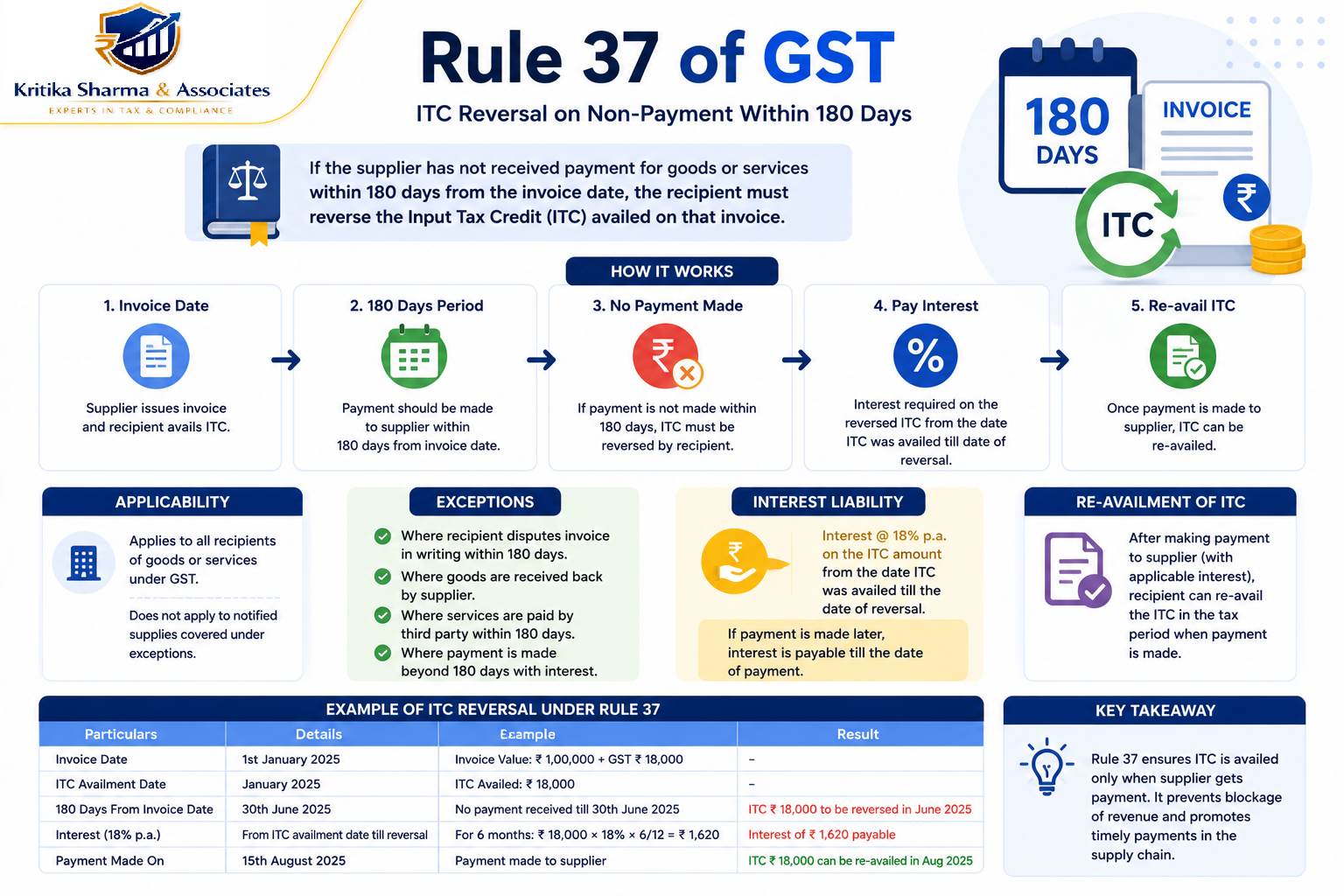
Under GST Rule 37, businesses must ensure timely payment to suppliers to retain the Input Tax Credit (ITC) claimed on purchases. If the supplier’s payment, including the GST component, is not made within 180 days from the invoice date, the proportionate ITC must be reversed along with applicable interest. The rule outlines the process for ITC reversal, reporting requirements, interest implications, and the conditions under which the reversed credit can be reclaimed once payment is made to the supplier.
It is very important to comply with Rule 37 to prevent any kind of ITC reversals, interest charges, and GST problems. This article discusses the applicability of Rule 37, its exceptions, calculation and reporting of ITC reversal, the process of reclaiming the ITC reversal, and practical examples.
What is Rule 37 of GST?
As per Rule 37 of the GST regime, the registered person is supposed to reverse the input tax credit (ITC) that was made on a tax invoice if the payment of the GST amount is not done to the supplier within 180 days from the date of the tax invoice. Once the payment is done, the reversed ITC can be availed according to GST rules.
The above-mentioned 180-day rule comes from the second proviso of section 16(2) of the CGST Act. The above-mentioned rule 37 of the CGST rules implements the said proviso.
A quick clarification for readers: Rule 37 is often confused with Rule 37A. Rule 37 deals with the recipient’s own failure to pay the supplier within 180 days. Rule 37A is a separate provision that requires ITC reversal when the supplier hasn’t paid tax to the government (i.e., hasn’t filed GSTR-3B) — a different trigger with its own timeline. This article covers Rule 37 only.
What Rule 37 covers:
- The 180-day payment requirement for retaining claimed ITC
- ITC reversal on non-payment, calculated proportionately for the unpaid portion
- Interest liability on the reversed amount
- The option to reclaim ITC once payment is eventually made, with no time limit on reclaiming
| Particular |
Details |
| Rule |
Rule 37 of CGST Rules |
| Applies To |
Registered taxpayers claiming ITC |
| Trigger |
Non-payment within 180 days |
| Outcome |
ITC reversal with interest at 18% p.a. under Section 50(1) |
When Does Rule 37 Apply?
Rule 37 of GST applies when a registered taxpayer has claimed Input Tax Credit (ITC) on a tax invoice but does not pay the supplier the invoice value, including GST, within 180 days from the invoice date. In such cases, the proportionate ITC must be reversed along with the applicable interest, as per GST provisions.
Conditions for ITC Reversal
| Condition |
Requirement |
| Valid tax invoice |
Yes |
| Goods/services received |
Yes |
| ITC claimed |
Yes |
| Payment pending beyond 180 days |
Yes |
- Valid tax invoice: there must be a proper tax invoice for the supply; Rule 37 doesn’t apply to informal or unsupported claims.
- Goods/services received: the recipient must have actually received the goods or services — ITC on undelivered supplies is a separate issue under Section 16(2)(b).
- ITC claimed: the taxpayer must have already availed the credit in a GSTR-3B return.
- Payment pending beyond 180 days: the invoice value plus GST must still be unpaid, wholly or partly, once 180 days have elapsed from the invoice date.
How is the 180-Day Period Calculated?
The 180-day period runs from the date on the supplier’s tax invoice — not from the date the recipient claimed the ITC, and not from the date the goods or services were actually received.
- Identify the invoice date.
- Count 180 calendar days from that date.
- Check the supplier payment status as of day 180.
- Reverse the proportionate ITC in the GSTR-3B for the period in which the 181st day falls, if payment remains outstanding.
Important: The calculation starts from the invoice date, not the date the ITC was claimed — this distinction matters when there’s a gap between receiving the invoice and actually filing the return in which the credit is availed.
When is ITC Reversal Not Required?
ITC reversal under Rule 37 is not required in specific cases prescribed under GST law, such as supplies liable to the Reverse Charge Mechanism (RCM) and certain transactions where payment to the supplier is not a statutory condition. Taxpayers should verify applicable exceptions before reversing ITC to ensure accurate GST compliance.
Exceptions to Rule 37
| Exception |
Explanation |
| Reverse Charge Mechanism (RCM) |
Rule 37 doesn’t apply — the recipient itself pays GST directly to the government, so there’s no “unpaid GST to a supplier” scenario |
| Schedule I transactions |
Deemed supplies made without consideration (e.g., between related parties) don’t involve a payment obligation, so the 180-day test doesn’t apply |
| Other notified cases |
Any further exclusions specifically prescribed under GST law or notifications |
- RCM supplies are expressly carved out in the text of Rule 37(1) itself, since the recipient — not a third-party supplier — is the one discharging GST.
- Schedule I transactions (like stock transfers between distinct persons of the same entity) have no “payment to supplier” concept, so the provision has nothing to test.
- Businesses should check for any additional carve-outs before applying Rule 37 mechanically to every unpaid invoice.
How to Calculate ITC Reversal Under Rule 37
The reversal of Input Tax Credit under rule 37 is done according to the ratio of the outstanding invoice amount that is 180 days old from the day of the invoice date. Only that portion of Input Tax Credit will have to be reversed which corresponds to the outstanding amount of the invoice.
Formula for ITC Reversal
ITC to be Reversed = ITC Claimed on Invoice × (Unpaid Invoice Value / Total Invoice Value)
This proportionate approach — reversing only the ITC attributable to the unpaid portion, not the entire invoice — was clarified retrospectively from 1 October 2022 by Notification No. 26/2022-Central Tax. Where the invoice is fully unpaid at day 180, the entire ITC claimed on it must be reversed.
Example of ITC Reversal Calculation
Example of ITC Reversal Calculation Under Rule 37
Assume a business receives an invoice with the following details:
| Particular |
Amount |
| Total Invoice Value (including GST) |
₹1,18,000 |
| Taxable Value |
₹1,00,000 |
| GST Amount |
₹18,000 |
| ITC Claimed |
₹18,000 |
| Amount Paid to Supplier within 180 days |
₹70,800 |
| Outstanding Invoice Amount after 180 days |
₹47,200 |
Since ₹47,200 remains unpaid after 180 days, the proportionate ITC related to the unpaid portion must be reversed.
Formula:
ITC to be Reversed = ITC Claimed × (Unpaid Invoice Value ÷ Total Invoice Value)
ITC to be Reversed = ₹18,000 × (₹47,200 ÷ ₹1,18,000)
ITC to be Reversed = ₹18,000 × 40%
ITC to be Reversed = ₹7,200
Therefore, the business must reverse ₹7,200 of ITC in its GST return. The remaining ITC of ₹10,800 relating to the portion already paid to the supplier can continue to be retained.
If the supplier is paid later, the reversed ITC of ₹7,200 can be re-claimed in the GST return for the period in which the payment is made. Interest liability, wherever applicable, will be calculated separately on the reversed amount for the period from the date of ITC availment until the date of reversal.
If part of the invoice value remains unpaid after 180 days, only the ITC proportionate to that unpaid part is reversed; the credit relating to the paid portion stays intact. Interest is calculated separately on the reversed amount for the period it stayed on the credit ledger, from the date it was claimed to the date of reversal.
How to Reverse ITC Under Rule 37
To reverse ITC under Rule 37, taxpayers must identify invoices that remain unpaid beyond 180 days, calculate the proportionate Input Tax Credit to be reversed, report the reversal in the applicable GST return, and pay any applicable interest. Proper documentation and timely reporting help ensure compliance with GST regulations.
Reporting ITC Reversal in GST Returns
- Identify unpaid invoices crossing the 180-day mark.
- Calculate the proportionate reversal.
- Report the reversal in GSTR-3B, as a reduction to eligible ITC in Table 4(B)(2).
- Maintain reconciliation records for the invoice, payment status, and reversal calculation.
| Activity |
GST Return |
| ITC Reversal |
GSTR-3B (Table 4(B)(2)) |
| ITC Reclaim |
GSTR-3B, in the period payment is made |
Interest Liability on ITC Reversal
Interest applies on the reversed ITC amount for the period it remained available on the taxpayer’s credit ledger — from the date the credit was availed (or, per Rule 88B, from the date it was actually utilised, where the balance was insufficient to cover it) until the date of reversal.
| Particular |
Details |
| When interest applies |
ITC reversed after non-payment beyond 180 days |
| Interest rate |
18% per annum |
| Applicable provision |
Section 50(1) of the CGST Act, read with Rule 88B |
Important: Under Rule 88B, if the taxpayer had a sufficient balance in the electronic credit ledger throughout the period (i.e., the credit was never actually utilised to pay other tax liabilities), no interest is payable on the reversal — only the reversal itself is required. This makes tracking ledger utilisation, not just the reversal calculation, important for accurate compliance.
Can Reversed ITC Be Reclaimed?
Yes, reversed ITC can be reclaimed once the taxpayer makes the pending payment to the supplier, including the applicable GST amount. After fulfilling the payment condition, the eligible Input Tax Credit may be re-availed in accordance with the provisions of the GST law, subject to proper documentation and return filing requirements.
Conditions for Reclaiming ITC
- Payment made to supplier, covering both the invoice value and the GST amount
- Supporting documents available (invoice, payment proof)
- GST return filed correctly, reflecting the reclaim
- ITC otherwise eligible under GST law (not blocked under Section 17(5) or elsewhere)
Steps to Re-avail ITC
- Complete payment to the supplier — invoice value plus GST.
- Verify payment details against the original invoice and reversal calculation.
- Reclaim ITC in the GSTR-3B for the period the payment is made.
- Keep documentary evidence (payment proof, bank statement, ledger entries) for audit purposes.
There is no time limit on reclaiming ITC that was reversed under Rule 37 — unlike the standard time limit under Section 16(4) for claiming fresh ITC. However, the interest already paid during the reversal period is not refunded even after the credit is reclaimed; it remains a sunk cost of the delayed payment.
Practical Examples of Rule 37
Practical examples of Rule 37 help businesses understand when Input Tax Credit (ITC) reversal becomes necessary and how the amount is calculated for full or partial non-payment. These scenarios simplify the application of the 180-day payment rule, enabling taxpayers to comply with GST requirements and avoid interest liabilities.
Example – Full Non-Payment
| Particular |
Value |
| Invoice Value (including GST) |
₹1,18,000 |
| ITC Claimed |
₹18,000 |
| Payment Made |
Nil |
| Result |
Full ITC reversal of ₹18,000 |
Explanation: Since no payment was made to the supplier within 180 days from the invoice date, the entire ITC of ₹18,000 must be reversed. Interest, if applicable, will be calculated as per Section 50(1) read with Rule 88B.
Example – Partial Payment
| Particular |
Value |
| Invoice Value (including GST) |
₹1,18,000 |
| Amount Paid |
₹70,800 |
| Outstanding Amount |
₹47,200 |
| ITC Reversal |
₹7,200 (Proportionate) |
Explanation: Since ₹47,200 remains unpaid after 180 days, only the ITC attributable to the unpaid portion must be reversed. The taxpayer can retain the remaining ITC related to the amount already paid and reclaim the reversed ITC once the outstanding payment is made.
Common Mistakes to Avoid Under Rule 37
Businesses often make mistakes such as missing the 180-day payment deadline, incorrectly calculating ITC reversal, overlooking partial payments, or failing to reclaim eligible ITC after payment. Regular invoice reconciliation, timely vendor payments, and accurate GST return reporting can help prevent compliance issues, interest liability, and unnecessary tax disputes.
- Missing the 180-day deadline due to poor invoice-ageing tracking
- Reversing the entire ITC even where only part of the invoice is unpaid
- Ignoring partial payments when calculating the reversal amount
- Forgetting to reclaim ITC once the supplier is eventually paid
- Not maintaining payment records that clearly link a payment to a specific invoice
- Poor vendor reconciliation, leading to disputes over whether payment was actually made within 180 days
Case study of Rule 37 of GST : Sunny Jain v. Union of India & Ors.
Delhi High Court | 5 December 2022
Facts
GST authorities blocked the petitioner’s Input Tax Credit (ITC) of ₹1.37 crore in his Electronic Credit Ledger under Rule 86A of the CGST Rules, 2017. The action was based on an allegation that the petitioner had failed to pay a supplier within the prescribed 180-day period under Section 16(2) of the CGST Act.
The petitioner challenged the blocking, stating that the restriction continued beyond the permissible period and was not supported by the provisions of Rule 86A.
Issue
Whether failure to pay a supplier within 180 days allows GST authorities to block ITC under Rule 86A.
Judgment
The Delhi High Court held that the blocking of ITC was not legally sustainable. The Court observed that Rule 86A can be invoked only in specific situations mentioned in the rule, such as fake invoices, non-existent suppliers, or non-receipt of goods/services. Failure to pay a supplier within 180 days does not fall within these categories. The Court clarified that non-payment within 180 days is addressed through reversal/addition to output tax liability with interest, and not by blocking the Electronic Credit Ledger.
Key Takeaway
Rule 86A cannot be used as a general power to block ITC. Authorities must strictly follow the conditions prescribed under the law before restricting a taxpayer’s credit.
Why choose Vakilsearch?
Rule 37 compliance requires continuous monitoring of payments made by companies to suppliers, with a requirement to reverse Input Tax Credit (ITC) if invoices are not settled within 180 days.
Failure to make such reversals can subject businesses to interest charges and increased scrutiny during GST audits. Through Vakilsearch, you can automate ITC reconciliation, identify invoices requiring reversal, calculate applicable interest, and reclaim ITC once payment is made to the supplier.
Our GST experts also assist with GST return filing, compliance management, reconciliations, and GST notices, helping your business remain compliant while reducing the risk of errors and penalties.
Conclusion
CGST Rule 37 provides that Input Tax Credit (ITC) can be retained only if payment to the supplier is made within the prescribed period of 180 days.
If payment is delayed beyond this period, businesses must reverse the ITC along with the applicable interest. However, the reversed ITC can be reclaimed once the outstanding invoice is paid. Regular reconciliation of purchase ledgers, supplier invoices, and payment records helps businesses comply with Rule 37, avoid interest and penalties, and maintain accurate GST records.